BMW "New Class": The "Super Brain" in Extreme Testing
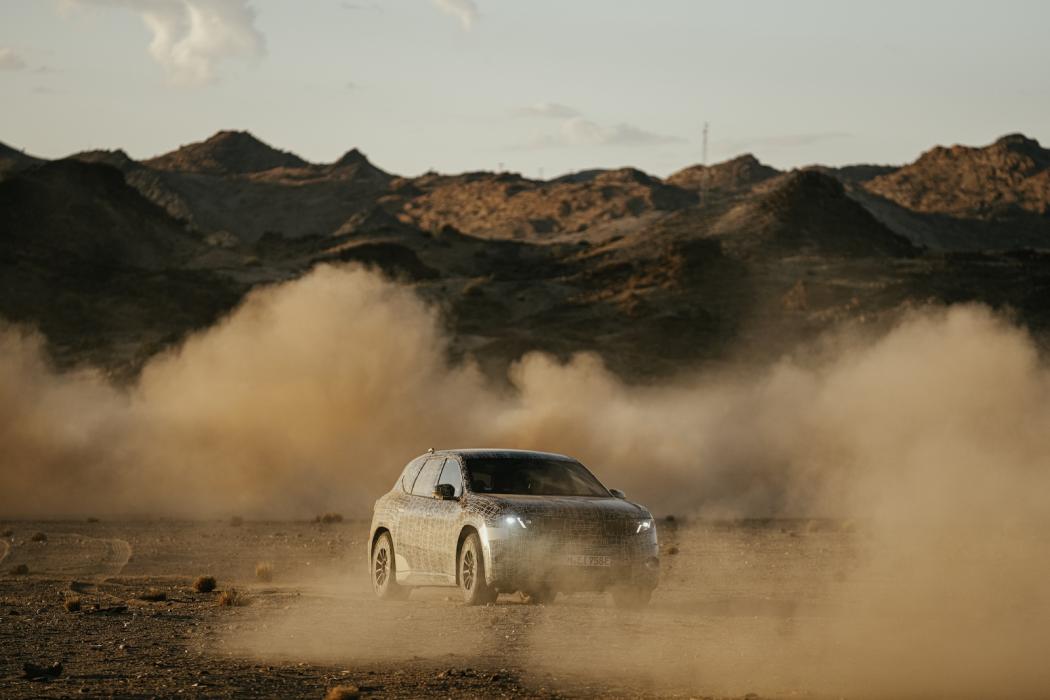
Heat, freezing cold, dust, rain, snow: currently, prototypes of the new class are making their final test rounds. Numerous test vehicles from increasingly summery Munich are now on the road all over the world. In addition to driving tests in Europe, testing in wintry Lapland and the scorching test tracks between the Cape region and the border with Botswana in South Africa is of key importance. Soon, the cumbersome designation of the "new class" will also be a thing of the past. BMW has painstakingly attempted to connect historically with the new class of the 1960s, which was indeed a new beginning for Bavaria back then. However, the step with the upcoming new class and the six models planned for it is obviously not as monumental, as BMW is better positioned than many competitors – unlike in the early 1960s.
The "New Class" is more of a synonym for the future
However, Head of Development Frank Weber emphasizes that the new class of 2025/2026 is by no means about a single vehicle, but rather a major transformation in a central area of the model portfolio. From the mid-range series of the 3 series and X3, central processes in production, development, value creation, and platform will expand to all series: "The new class is designed exclusively for electric vehicles," said Weber. Even the design will impact the entire BMW range faster than many think, as the still young models of the 5 series / i5 and 7 series / i7 will acquire central features of the New Class models both inside and out in their revisions.
In addition to a large central display, all future new models will provide information to the driver via the Panoramic iDrive rather than conventional instruments; a display that spans the entire width of the lower windshield and entertains all passengers with various content. "Starting with the first production model of the new class at the end of the year, the new BMW Panoramic iDrive will be an integral part of all new BMW vehicles," Weber explained. However, there will still be a head-up module alongside the new iDrive.
Starting in Fall 2025 with the iX3 – made in Hungary
The new BMW iX3, which will debut in the fourth quarter of 2025 after the IAA in Munich, marks the beginning of the upcoming model family. With its design and technology, it shares significant similarities with the BMW i Vision Dee and BMW Vision New Class X concepts. "The New Class is our project of the century," emphasized BMW Purchasing Director Dr. Joachim Post. Currently, the upcoming BMW iX3 and its sedan sibling i3, which will follow in 2026, are driving thousands of test miles in the hot and dusty South Africa. In addition to durability, the focus is on heat management for the vehicle, battery, and drive technology. Following the electric mid-size crossover of the iX3, a total of five more new BMW models will be launched by the end of 2027, forming the heart and backbone of the brand. The BMW i3 will follow in 2026, which will also come in a Touring version from the end of 2026 to attract electric fans. The BMW i3 / i3 Touring will feature the next generation of electric motors for its drives. These vehicles will be available with rear and all-wheel drive options, producing between 200 and 500 horsepower. The upcoming electric three-series will deliver performance like no other mid-size model from Munich before.
Huge step in efficiency
The models of the new class are expected to be about 20 percent more efficient, charge approximately 30 percent faster, and have an electric drive system that costs around 50 percent less than before. BMW is switching to self-developed cylindrical cells for the energy storage. Two variants are available: one with a height of 95 millimeters and another with 120 millimeters. The diameter remains the same at 46 millimeters. Thus, the batteries are flat, part of the body with the "pack-to-open-body concept," and seal the car from below. This saves weight and costs. For BMW energy storage assembly, the principle is "local-to-local," meaning in key sales regions and close to the vehicle factories: Irlbach-Straßkirchen (Lower Bavaria), Debrecen (Hungary), Shenyang (China), San Luis Potosí (Mexico), and Woodruff near Spartanburg (USA).
Four Superbrains instead of numerous control units
But the software is also advancing significantly: The BMW Group is the first automotive manufacturer to launch a completely newly developed digital "nervous system" for all drive variations and vehicle segments. It is intended to be smarter, more powerful, and more efficient. And, it will be used for the first time in the models of the New Class. Four high-performance computers, also called "Superbrains," bundle the computing power for the most important customer functions, including infotainment, automated driving, driving dynamics, and basic functions like vehicle access, climate, and comfort. According to BMW, the four Superbrains have well over 20 times the computing power compared to the current vehicle generation and are already designed for upcoming software and function updates, including tangible AI features. Frank Weber, Head of Development at BMW AG, explains:
"Technological openness is the key to BMW's success. Starting with the first model of the New Class at the end of the year, we are rolling out the technologies of the New Class across the entire future model portfolio – across all segments and all drive types. This also naturally applies to our completely newly developed electronic architecture of high-performance 'Superbrains' and highly connected software platforms. This architecture allows us to decouple vehicle and software development. The advantage: More so than today, all future BMW models will stay digitally up to date through over-the-air upgrades and will also receive updates from the next and following vehicle generation."
The wiring harness has been "radically simplified": saving 600 meters of cable!
An elemental part of the "digital nervous system" is, according to BMW, the radically simplified wiring harness. This is based on a so-called zonal wiring harness architecture that operates with 600 meters less wiring and brings a 30% weight savings compared to the previous generation. The wiring harness is divided into four zones: front end, body, rear, and roof.
The Superbrains are networked with smaller control units, the zone controllers, via high-speed data connections. These control and bundle the data flow of the electronics in and out of the zones. Thus, the cables in the vehicle are zone-based and can be shorter, thinner, and lighter.
They also took a completely new approach with the fuses
A crucial requirement for thinner and lighter cables are the so-called "Smart eFuses". These are digital fuses that can replace up to 150 traditional melting fuses. Smart eFuses can be intelligently programmed for digitally controlled power distribution to components. The selective activation of components allows the design of intelligent power modes for various vehicle states such as driving, parking, charging, and upgrading, in which unnecessary consumers are selectively switched off. The eFuses thus make a significant contribution to the 20% improved energy efficiency.
The completely newly developed electronic architecture forms the basis for the next generation software-defined vehicle. Starting with the launch of the Neue Klasse, the upcoming BMW model generation will benefit from it. The first electric derivative of the Neue Klasse will go into series production later this year at the Debrecen plant (Hungary).
Digital functions do not always have to be developed anew
Basically, BMW is acting here in a way similar to Volvo: the further developed software architecture of the entire BMW Group is built on the new electronic architecture. According to BMW, in the abundance of digital functions in the Software Defined Vehicle, it is crucial that functions are not always newly developed but can be continuously further developed on stable software platforms. This is precisely what is achieved with the Neue Klasse. In the vehicle, the software platforms run on their respective superbrains and, in turn, the vehicle functions. The "Shared Service Layer" acts as a connecting element (middleware) and ensures, among other things, state-of-the-art cybersecurity and flexible over-the-air updates. Moreover, it enables customer-value AI functions thanks to the intelligent networking of cross-domain data sources.
"With the introduction of the Neue Klasse, we are entering a mode of software development in which we achieve software continuity. This means we continually develop software further, not always anew," explains Christoph Grote, Head of BMW Group Electronics and Software, and adds:
"Based on our further developed software architecture and the fact that today we generate 130 times more software daily with our global developer teams than 10 years ago, we see ourselves in an excellent competitive position. Our software developers can focus more than ever on product innovations."
Software development has increased 130-fold in the last ten years!
For the Neue Klasse, developer teams are working on well over 1,000 software modules, with over 20 GB of software and over 500 million lines of code, which are ultimately integrated into the superbrains and the rest of the vehicle's electronic architecture. According to BMW, the heart of vehicle software development is the integrated development environment: a tailored tool chain called "CodeCraft". The speed and quality of development have been enhanced by the use of a variety of tools that support software developers with generative AI. CodeCraft runs in the cloud on up to 75,000 virtual processors, supports the simultaneous work of well over 10,000 software developers, and records up to 200,000 software builds per day at its peak. This corresponds to a productivity increase of more than 130 times compared to 10 years ago.
What does that mean?
The latest news from Petuelring sounds promising: BMW is indeed preparing for a comprehensive "restart" with the "Neue Klasse" – also in terms of software. May it succeed!
Reporting for us from the Cape and Scandinavia: Wolfgang Gomoll and Stefan Grundhoff from press-inform
Sources: BMW, Press-Inform
Translated automatically from German.