Is Citroën bringing back the 2CV?
In France, the automotive clocks tick slightly differently: Here, the big names (still) are Citroën and Peugeot on one side, and Renault with — recently Dacia — on the other side. And since Luca de Meo announced the "Renaulution" in the Renault Group, the electric R5 has outpaced the Citroën ë-C3 and pushed Dacia as a brand well ahead of Citroën to rank fourth...
The Renault 5 sells better than the Citroën ë-C3
The figures from November 2024 show: 9,973 Renault 5s compared to 8,252 Citroën ë-C3s — neither are bad numbers, but the Renault is thus the new "It-Car" of the French. Thanks to the R5, according to Autocar, Renault's market share in the French electric car market from January to October rose from 16.3% to 23.2%. Similarly in Germany, where in January 2025, 347 newly registered R5s faced only 81 ë-C3s. Charm works!
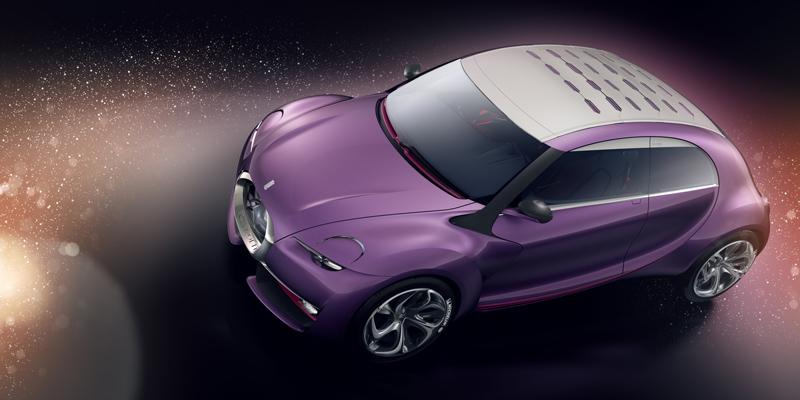
Now, Citroën had already presented a "luxury 2CV" as a concept at the IAA 2009: The "Revolte" was a test but failed miserably. Visually more of a hot rod and luxuriously equipped, fans rather perceived it as a "betrayal" of the original. But times have changed: Cars have become expensive, and the call for affordable, simple models that should also be fun has grown louder. Renault is following up the R5 with the R4, and the creator of the former then went to Stellantis and created the "Grande Panda" there, which, compared to the understated ë-C3, is also a charmer.
Which is why Stellantis, and especially Citroën, seem to be rethinking: Retro is back in — if it is done well. At DS, we have already seen potential successors to the 3 or 4 on the computers that strongly leaned towards the "Goddess" of 1955 more than the DS 8 and others — but still didn't seem tacky. We liked what we saw!#
The Ami quotes the original 2CV in details
And in Paris, the new Ami stood, adopting several design elements of the original 2CV, including the upright round headlights, ventilation-like indentations on the fenders, and the historic Citroën logo that all new models of the brand carry.
And a senior staff member reportedly confirmed to Autocar that initial design work for a successor to the "Duck" has been initiated, although the project is said to still be in an early phase according to Autocar. This suggests a change in direction at Citroën, where any intention to revive the Duck had previously been rejected.
Autocar also inquired with Pierre Leclercq, Citroën's design chief, who was very discreet in his comments:
"What people remember about Citroën is not necessarily that one wants to repeat the form of successful vehicles. But we are not closed to it. Philosophy is important."
This means that simplicity and affordability could probably be central considerations in the development of the new 2CV. Because the original, whose development started even before the Second World War, was conceived as a functional minimalist to provide individual motorized mobility to a broad population in rural post-war France. The basis is likely to be the Smart Car platform. It is also used by C3, Frontera, and Grande Panda. And to further cut costs, the equipment might be slimmed down: Even the C3 — the cheapest vehicle on this platform so far — uses hydraulic shock absorbers, comes with air conditioning, and electric windows.
And: one could use an extra small battery for low entry prices, which Renault also does. Additionally, the drive would probably be more focused on efficiency than on power, as the Grande Panda was not particularly economical in winter. So there's still room for improvement.
Because Citroën CEO Thierry Koskas explained to our colleagues at Autocar that batteries still represent the biggest hurdle for lowering the prices of new electric cars, as they account for around 40% of the total cost of a vehicle. He explained:
“We need a breakthrough in battery costs.”
This brings us to the Dacia Spring, which consistently makes it into the top ten best-selling cars in Germany and left both the Renault 5 and Citroën ë-C3 far behind with 868 units in January 2025! However, its 26.8-kWh battery is almost too small for everyday use. Anyone wanting to drive more than 150 kilometers will find it stressful... Also: The smart car platform can accommodate mild hybrids – much cheaper than electric.
Interesting: Renault’s designers conceived the new Renault 5 exclusively as an electric vehicle: a combustion engine would have required a longer hood, impairing the snappy design. As the new R4 will be positioned above the R5, the “Duck” could bridge the gap between Ami and C3 and might even start electronically around €15,000, because: It does not need to be powerful or luxurious, just – simple!
Release date: 2028 - for the 80th anniversary of the original
According to Autocar, it is still unclear when the new 2CV could be launched. With a typical development cycle of four years, 2028 is possible – which would coincide exactly with the 80th anniversary of the original at the Paris Motor Show. That’s why we look forward to Paris 2028!
What does this mean?
The Citroën ë-C3 offers a decent package but remains somewhat bland: At first glance, it could almost be from Leapmotor or other brands. This is also reflected in sales, where the more charming Renault 5 simply pulls away. That’s why Citroën is considering a new Duck again. However, it must be much more distinctive than the R4 and must not suffer the fate of the VW Beetle, whose retro design ended after two generations. A somewhat challenging endeavor!
Translated automatically from German.